Moustaki Bookkeeping Services Becomes a Companies House Authorised Agent
July 23, 2026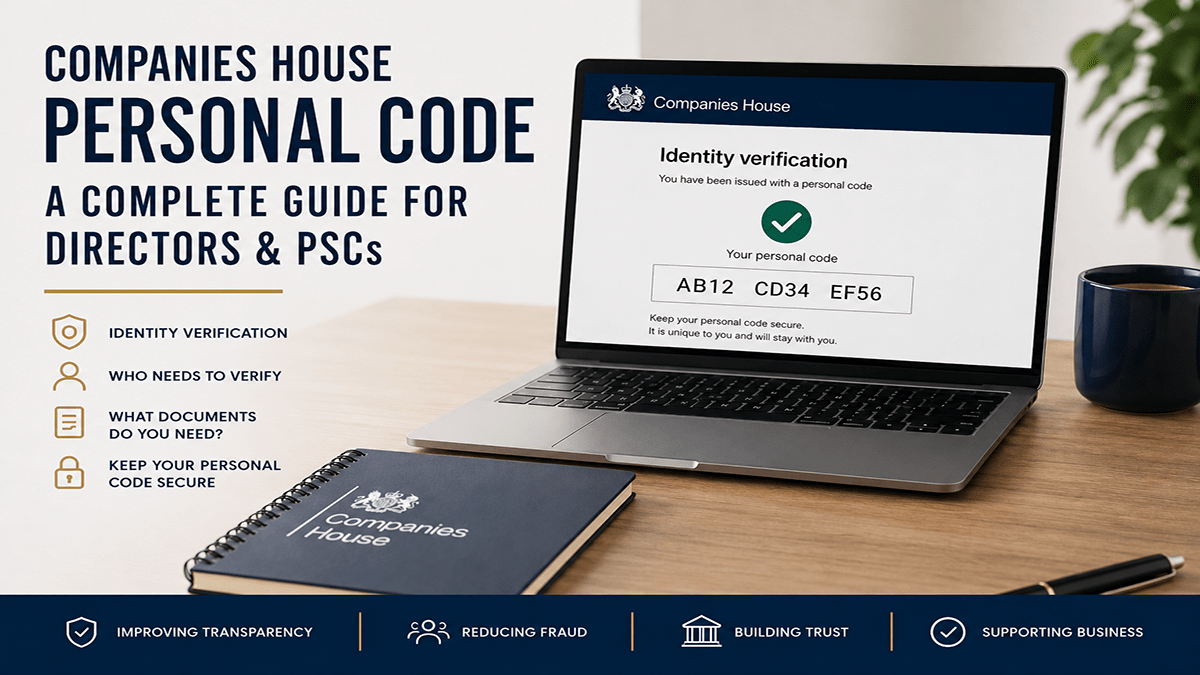
Companies House Personal Code: A Complete Guide for Directors and PSCs
The way individuals interact with Companies House is changing.
As part of the Companies House reforms introduced under the Economic Crime and Corporate Transparency Act, many people connected to UK companies will be required to verify their identity and obtain a unique Companies House personal code.
If you are a company director, a Person with Significant Control (PSC) or are planning to form a company in the future, it is important to understand what these changes mean and what action you may need to take.
What Is Companies House Identity Verification?
Identity verification is a new requirement introduced by Companies House to help improve the accuracy of the public register and reduce the risk of fraud.
The purpose is simple: Companies House wants to ensure that the individuals listed as directors, PSCs and company officers are genuinely who they claim to be.
Once your identity has been successfully verified, you will be issued with a unique personal code which becomes linked to your identity.
This code will remain with you even if you become involved with multiple companies during your lifetime.
Who Needs to Verify Their Identity?
The requirement applies to a wide range of individuals involved with UK companies, including:
- Existing company directors
- Newly appointed company directors
- People with Significant Control (PSCs)
- LLP members
- Individuals forming a new company
- Certain individuals filing information at Companies House on behalf of companies
If you are currently listed as a director or PSC, it is highly likely that you will need to complete identity verification.
What Is a Companies House Personal Code?
A Companies House personal code is a unique identifier issued after your identity has been verified.
Think of it as your personal reference number with Companies House.
The code helps Companies House link you to your verified identity and ensures that future appointments and filings can be connected to the correct individual.
Unlike a company number, which belongs to a business, the personal code belongs to you as an individual.
How Do You Obtain a Personal Code?
You must first complete identity verification.
There are two ways to do this:
Option 1: Verify Directly with Companies House
You can verify your identity yourself using the Companies House identity verification service and a GOV.UK One Login account.
To start the process, visit:
Verify your identity with Companies House
https://www.gov.uk/guidance/verify-your-identity-for-companies-house
Before you begin, make sure you have access to an accepted form of identification and a smartphone or device capable of completing the identity checks.
Once your identity has been successfully verified, Companies House will issue your personal code. You should keep this information secure and only share it when necessary with trusted professional advisers or authorised parties.
Option 2: Use a Companies House Authorised Agent
A Companies House Authorised Agent can verify your identity on your behalf and submit confirmation directly to Companies House.
Many business owners prefer this option because it allows them to complete the process with the assistance of their accountant or adviser.
What Documents Will You Need?
The documents required will depend on whether you verify your identity directly with Companies House or through a Companies House Authorised Agent.
For many individuals, particularly overseas directors and shareholders, a biometric passport is often the simplest and most widely accepted form of identification.
Examples of documents that may be accepted include:
- A biometric passport from any country
- A UK photocard driving licence (full or provisional)
- An EU or EEA photocard driving licence (in certain verification routes)
- A national identity card issued by an EU country, Norway, Iceland or Liechtenstein
- A UK Biometric Residence Permit (BRP)
- A UK Biometric Residence Card (BRC)
- A UK Frontier Worker Permit
Depending on the verification method used, you may also be asked to provide:
- Proof of your current residential address
- Evidence of a name change (such as a marriage certificate or deed poll)
- Additional supporting documentation where identity cannot be confirmed from a single document
If you are verifying through a Companies House Authorised Agent, a wider range of documents may be accepted, including certain immigration documents, birth certificates, marriage certificates and other supporting evidence where appropriate. The exact documents required will depend on your individual circumstances.
If you are an overseas director or shareholder and are unsure which documents are suitable, it is advisable to speak with your authorised agent before starting the verification process.
Tip for Overseas Directors
If you hold a biometric passport, you will usually find the identity verification process significantly quicker and simpler than using alternative forms of identification.
What Happens If Your Details Have Changed?
If your name differs from the name shown on your identification documents, Companies House or your authorised agent may request supporting evidence.
Examples include:
- Marriage certificate
- Civil partnership certificate
- Deed poll documentation
- Other legal name change documents
Providing these documents early can help avoid delays.
What Happens After Verification?
Once your identity has been verified:
- A unique Companies House personal code will be issued.
- Your identity verification status will be recorded by Companies House.
- Future appointments and filings can be linked to your verified identity.
- You will not need to repeat the process each time you become involved with a different company.
Your personal code is intended to stay with you throughout your business activities.
Keep Your Personal Code Secure
Your Companies House personal code is unique to you and should be treated as sensitive information.
Although it is not intended to be used in the same way as a password, it helps Companies House link filings and appointments to your verified identity. For this reason, it should only be shared when necessary and with trusted parties, such as your accountant, company secretary or other professional advisers acting on your behalf.
As a general rule, you should treat your Companies House personal code with the same level of care as other important personal identifiers, such as your National Insurance number or Unique Taxpayer Reference (UTR).
You should never:
- Share your personal code publicly.
- Include it in unsecured emails or documents where possible.
- Provide it to individuals or organisations unless you understand why it is being requested.
- Publish it on websites, social media or publicly accessible records.
Keeping your personal code secure will help protect your identity and reduce the risk of unauthorised filings or misuse of your Companies House records.
What Happens If You Do Not Verify Your Identity?
Failure to comply with identity verification requirements may result in:
- Delays in company filings.
- Rejection of certain submissions.
- Restrictions on acting as a company director.
- Difficulties incorporating new companies.
- Potential enforcement action by Companies House.
For this reason, it is advisable not to leave the process until the last minute.
Frequently Asked Questions
Do I Need to Verify My Identity If I Already Have a Limited Company?
Yes. Existing directors and Persons with Significant Control will be required to comply with the new identity verification requirements.
Do Overseas Directors Need to Verify Their Identity?
Yes. The requirements apply regardless of where you live. Overseas directors and PSCs will also need to complete identity verification.
Will I Need a New Personal Code for Every Company?
No. Your personal code belongs to you as an individual and can be used across multiple companies.
Can My Accountant Verify My Identity for Me?
Yes, provided your accountant or adviser is registered as a Companies House Authorised Agent and is authorised to carry out identity verification checks.
How Moustaki Bookkeeping Services Can Help
As a Companies House Authorised Agent, we can assist directors, PSCs and business owners with identity verification requirements and guide them through the process from start to finish.
Whether you are based in the United Kingdom or overseas, we can help you understand the requirements, identify the documents needed and complete the verification process correctly.
If you are unsure whether the new rules apply to you or would like assistance obtaining your Companies House personal code, please get in touch.
We will be happy to help.
Last updated: June 2026
Companies House guidance is evolving as the new identity verification regime is rolled out. We will update this article as further guidance becomes available.